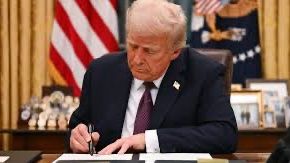
President Donald Trump signed a proclamation Thursday imposing a 15 percent tariff and a set of minimum import prices on polysilicon and its derivative products, citing a national security threat from foreign supplies of a material used in both semiconductors and solar panels.
The measures take effect December 4, according to Supply Chain Dive. They cover polysilicon ingots and specified derivatives, including solar wafers, cells and modules, along with certain semiconductor devices. Minimum import prices range from $21 per kilogram for raw polysilicon to 38 cents per watt for solar modules, Quartz reported.
The action follows a Section 232 investigation by the Commerce Department. The White House said the American share of global polysilicon production capacity has fallen from 50 percent in 2005 to under 2 percent in 2024, attributing the decline to foreign governments dumping the material into the US market.
White House staff secretary Will Scharf described the package as a series of trade actions intended to support domestic manufacturing and protect it from overseas dumping, Bloomberg reported.
Commerce Secretary Howard Lutnick spoke at the signing ceremony. He said the price floors were designed to prevent Chinese producers from undercutting American manufacturers, and the tariffs to push production onshore, according to the Wall Street Journal as cited by Quartz.
The proclamation also directs the Commerce Department to create an incentive program under which companies committing to build, expand or refurbish domestic facilities may import covered goods and equipment duty-free during construction.
The measures replace a narrower safeguard tariff on solar cells and modules that Trump imposed in his first term and that expired in February. The new action extends coverage across the full polysilicon supply chain.
The Consumer Technology Association warned before the announcement that tariffs on derivatives would be difficult to enforce, arguing that once polysilicon is incorporated into a chip there is no practical way to trace its origin. A trade attorney told Reuters that the gap before the December effective date gives importers time to rush shipments through.