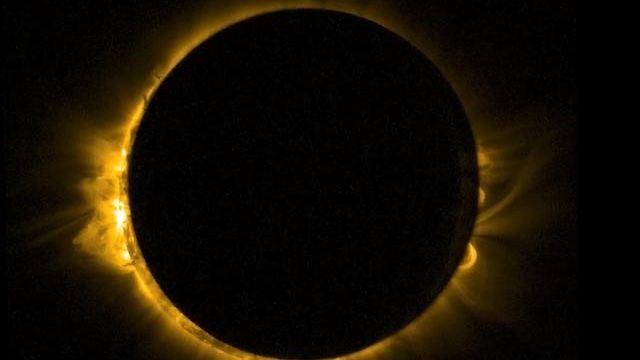
The only total solar eclipse of 2026 crossed the Northern Hemisphere on Wednesday, darkening skies from the Arctic to the Mediterranean in the first such event visible from mainland Europe since 1999.
The moon's shadow began its path at 15:34 GMT, racing from far northern Russia across Greenland and Iceland before reaching northern Spain and the Balearic Islands, according to Al Jazeera. A small corner of Portugal also fell inside the path of totality. At its longest, the sun was blocked completely for two minutes and 18 seconds.
Roughly 15 million people live inside that narrow band, most of them in Spain. CBS News reported that most major European cities saw at least 90 percent coverage, including Madrid, London and Paris. In Paris about 92 percent of the sun was obscured, in London 91 percent and in Berlin 85 percent, Al Jazeera reported.
Across much of Western Europe the eclipse arrived in the evening, with the sun setting while still partly covered. That timing created an unusual spectacle in Spain, where astronomers had anticipated a darkened landscape beneath an eclipsed sun sitting only a few degrees above the western horizon. The last total eclipse visible from mainland Spain occurred on Aug. 30, 1905, according to EarthSky.
North America saw far less. Parts of Alaska recorded the deepest coverage in the United States at about 37 percent, dropping to 28 percent in northeastern Maine, 10 percent in New York and almost nothing across the Midwest, Al Jazeera reported. In Canada, St. John's saw about 53 percent coverage, Montreal 18 percent and Toronto 8 percent.
Overall, about 980 million people were positioned to see the sun at least partly covered.
Scientists watched the event for a narrower reason. A total eclipse is the only occasion when the sun's outer atmosphere, the corona, becomes visible from the ground. Space.com reported that predictions for August placed the monthly sunspot number near 102, well below the 144 recorded during the April 2024 eclipse, suggesting a corona somewhere between the flattened shape of solar minimum and the tangled structure seen near peak activity.
The date carried two other events. A six-planet alignment was visible before sunrise at mid-northern latitudes, including New York, Madrid and Tokyo, and the Perseid meteor shower reached its peak after dark. Because the moon was new, NASA noted the sky remained dark enough for unusually good meteor viewing.
The next total solar eclipse falls on Aug. 2, 2027, crossing southern Spain, North Africa and Yemen.