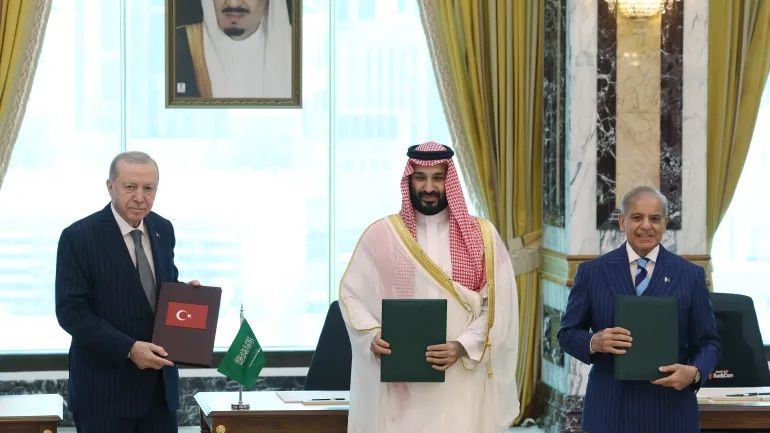
Saudi Arabia, Turkey and Pakistan signed a trilateral defense agreement in Mecca on Friday that treats an armed attack on any one of the three countries as an attack on all of them, officials said, formalizing security ties among three of the region's most powerful Sunni-majority states.
The pact was signed by Turkish President Recep Tayyip Erdogan, Saudi Crown Prince Mohammed bin Salman and Pakistani Prime Minister Shehbaz Sharif, according to Al Jazeera. Identical statements released by Pakistan's Foreign Ministry and Turkey's presidential communications office said the agreement is intended to strengthen collective deterrence against any act of aggression, CBS News reported.
The statement did not detail the specific commitments or obligations each country has accepted under what the parties are calling the Mecca Joint Defense Agreement, according to The Times of Israel. It said the pact aims to strengthen collective security and promote stability in the region and beyond.
The agreement follows nearly a year of negotiations, Al Jazeera reported. Signing it in Mecca, the holiest site in Islam, adds symbolic weight to ties that are already long-established: Pakistan has provided training and technical assistance to Saudi forces for decades, and Turkey and Pakistan have exchanged warships and training aircraft.
The three countries bring distinct capabilities. Turkey fields NATO's second-largest military and a rapidly expanding defense industry, Saudi Arabia is the world's largest oil exporter, and Pakistan is the only Muslim-majority country with nuclear weapons, according to Al Jazeera and CBS News.
Analysts told Al Jazeera the accord is a framework for closer strategic, military and defense-industrial coordination rather than an operational alliance. Mansoor Ahmed of the Australian National University told The Times of Israel that the pact is unlikely to include a nuclear component, as Pakistan's deterrent remains focused on India.
The agreement comes as fighting between Iran and the United States and Israel continues to disrupt Gulf energy exports and raise questions in Riyadh about the reliability of longstanding American security guarantees, Al Jazeera reported. Saudi Arabia and Pakistan signed a separate bilateral mutual defense pact in September.