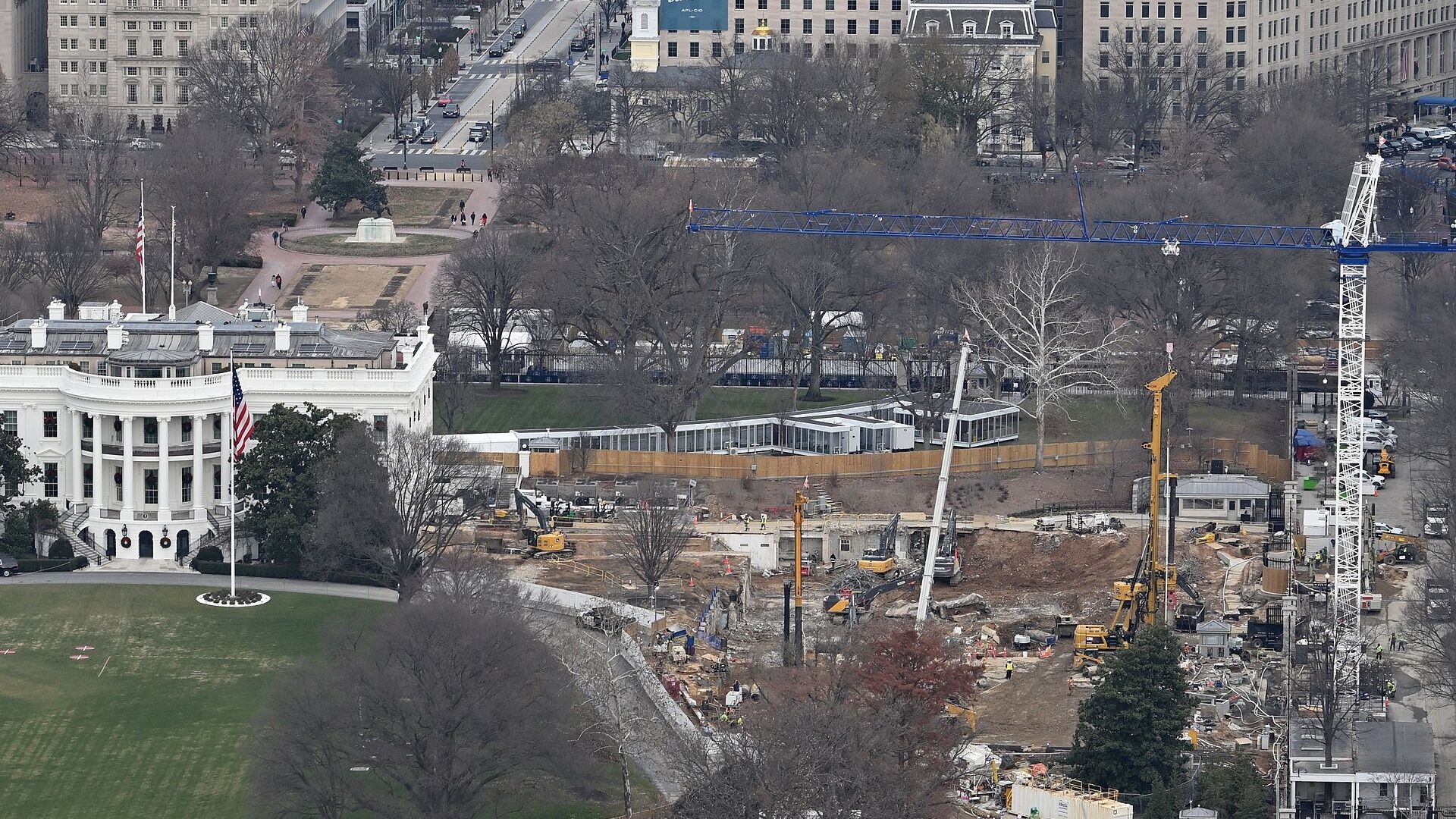
Chief Justice John Roberts on Friday put aside a lower court order that would have stopped aboveground construction on President Donald Trump's $400 million White House ballroom, letting the work continue while the Supreme Court weighs the administration's emergency appeal.
The order came hours before the injunction was to take effect at the end of the day, The Associated Press reported. It holds until the court rules again.
Roberts gave no reasoning. The order carried no vote count and no dissent and set no new deadline, Roll Call reported. Because a single justice handled it as an administrative stay, he is expected to send the case to all nine members of the court, CNN reported.
The docket lists the case as National Park Service v. National Trust for Historic Preservation. Roberts stayed a preliminary injunction from the U.S. District Court for the District of Columbia that a divided panel of the U.S. Court of Appeals for the D.C. Circuit upheld earlier this month. That panel found the administration had built without congressional authorization.
"Whether or not a massive ballroom should be constructed is for Congress to decide," the D.C. Circuit wrote in its 2-1 ruling, adding that it was not a matter for executive self-help, CNN reported.
Solicitor General D. John Sauer argued in the emergency application that the injunction intrudes on the president's authority over the White House complex. He described the ballroom as part of an integrated security and military project rather than a stand-alone event space.
The administration says 65% of the work is finished on the 90,000-square-foot ballroom, which sits where the East Wing stood before Trump ordered it torn down last year. Trump wrote on social media that the project is "under budget and ahead of schedule," The Associated Press reported.
The price has risen repeatedly. The administration first cited $200 million, then $300 million. This month Trump said nearly $400 million had been spent. Internal contracts obtained by The Washington Post put the combined cost of his changes to the White House complex, including the Rose Garden and a helipad, at roughly $900 million, CNN reported.
Bloomberg reported that the lower courts found Trump was flouting the law by building without congressional approval, and that the appeals ruling would have forced work to stop Friday.
A spokesperson for the National Trust for Historic Preservation said the order is not a final decision and the group is waiting for the court to act again, according to The Associated Press. The justices are expected to decide next whether construction may continue for the length of the case.