
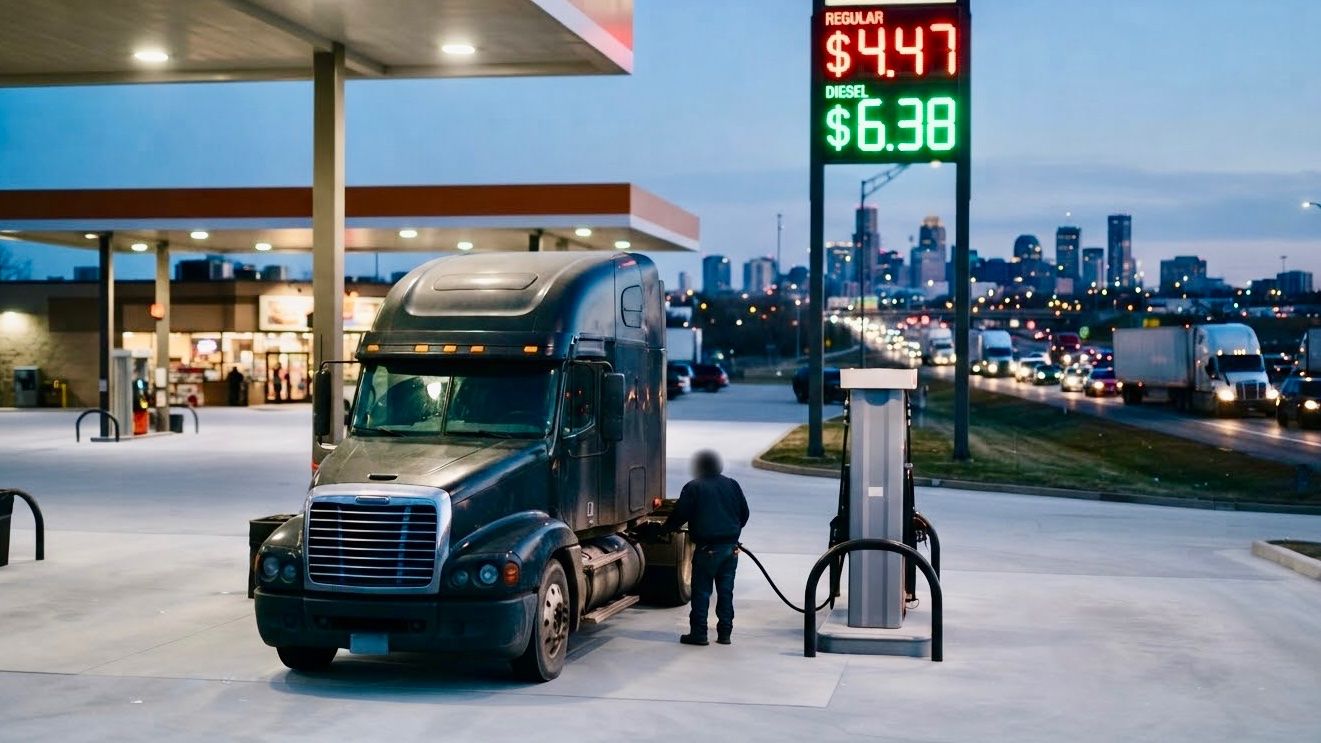
The higher price at the gas station is the most visible result of more expensive oil. But its effects don't end at the fuel tank. The products on store shelves first have to be made and shipped. Building materials have to reach the job site. Airlines have to buy fuel to fly their passengers. When costs rise along the way, businesses face a choice: raise prices, accept lower profits or scale back operations.
In 2026, that connection has been especially visible against the backdrop of the war between the United States and Israel on one side and Iran on the other. The war, which began in late February, sharply curtailed energy shipments through the Strait of Hormuz and disrupted production and refining in the region. The disruptions have since spread to the international market.
That is why oil prices affect even the budgets of people who don't own a car. How hard the impact lands depends on how much fuel a given business needs and how easily it can pass higher costs on to customers.
What the price of oil means
Reports on the global market often cite the price of Brent. Brent is a benchmark tied to North Sea crude, used in international trade to compare and set prices for many types of oil. According to the September 2026 report from the U.S. Energy Information Administration (EIA), Brent averaged about $69 a barrel in 2025, and the agency forecasts a 2026 average of $91. The August average was also $91, up $7 from July.
Why so many industries need oil
Electric vehicles and other energy technologies are gradually reducing the need for oil, but they haven't replaced it yet. Gasoline and diesel power cars and trucks, and fuel made from oil is used in aviation as well. Petroleum products are also needed in manufacturing and to make materials such as plastic and a wide range of chemicals.
These links run through the whole economy. The price of a food product, for example, can include fuel for farm equipment, packaging and transport to the store. More expensive fuel raises some of those costs, though the final price also depends on other factors: the harvest, labor costs, competition and consumer demand.
So a rise in oil prices doesn't make every good more expensive to the same degree or at the same time. The effect is likely to be more noticeable where fuel or petroleum-based raw materials make up a large share of costs.
What drives oil prices up
The price of oil depends largely on how much the world needs and how much is available on the market. When economic activity picks up, demand for fuel often rises too: companies produce and ship more, and people travel more. If supply can't keep pace, upward pressure on prices builds. A slowing economy often reduces demand.
Decisions by producing countries also affect supply. OPEC is the Organization of the Petroleum Exporting Countries. The "+" refers to other producers that are not members of the organization but cooperate with it; the expanded group is known as OPEC+. The countries agree on how much oil to pump. All else being equal, cutting output pushes prices up, and raising it pushes them down. The activity of the United States and other producers matters as well, as does the smooth operation of supply routes.
Prices sometimes rise on the expectation of a shortage, too. If market participants believe a conflict or a disrupted shipping route will cut future supply, that risk is priced into current trading.
Consumers and producers can't adjust to change quickly. However much prices rise, people still have to get to work and companies still have to deliver goods. Starting additional production also takes time and investment. That makes lost supply hard to replace quickly, and even a small shortfall can push prices up sharply.
What is happening in 2026
By the EIA's September estimate, global oil inventories have fallen by about 400 million barrels since the start of the year. That means the world drew on stored oil to cover the shortfall in supply.
The agency's forecast calls for a gradual increase in supply from the Middle East, but it doesn't expect production in the region to return to its prewar average until the second quarter of 2027. The report puts considerable weight on the resumption of shipping through the Strait of Hormuz and the use of alternative routes.
The Strait of Hormuz is a narrow waterway between Iran and the Arabian Peninsula through which oil from the Persian Gulf countries reaches the international market. Disruption there makes it harder to get oil that has already been produced to the people who need it.
The International Energy Agency (IEA), which studies energy markets and energy security in countries around the world, notes that the difficulties also hit refining and exports of finished fuels. So the problem isn't only the amount of crude: the market may be especially short of diesel or jet fuel.
This is where the economic significance of political events becomes clear. A conflict moves prices when it damages production and refineries, restricts shipping or raises the risk that shipments will be disrupted.
Why U.S. production doesn't fully shield the country
According to the EIA's official summary table from September, U.S. crude oil production is expected to average about 13.8 million barrels a day in 2026. That is an important source of supply, but it doesn't make the country independent of the global market.
The United States both exports and imports oil and petroleum products. Some of the imported crude is refined in American plants, and the resulting fuel can be sold at home or exported.
That's why a shortage in another region also affects American buyers: to get the available oil and fuel, they have to compete with buyers in other countries. High domestic production doesn't insulate the U.S. from world prices.
Nor can crude oil go straight into a car. A refinery has to process it first, and then the fuel has to reach the place where it is sold. So the availability of crude and the availability of gasoline or diesel in a particular region are not the same thing.
Stockpiles: temporary relief
Stockpiles are an additional source of supply when deliveries are disrupted. Companies keep oil and fuel on hand for day-to-day operations, and governments build emergency reserves to use in a crisis.
According to the IEA, on March 11, 2026, its member countries agreed to make 400 million barrels from emergency stocks available to ease the supply disruption. All 32 member countries backed the decision unanimously.
Drawing on stockpiles buys time, but it is no substitute for steady production and functioning shipping lanes. If the disruption drags on, the stored supply dwindles.
How higher prices reach the household budget
According to the EIA, the average price of regular gasoline in the United States on Sept. 28 was $4.465 a gallon, up $1.347, or about 43%, from the same week a year earlier. For people with no realistic alternative to driving to work, it is hard to cut back on the cost of getting around. If income doesn't rise, the extra money comes out of other purchases or out of savings.
The diesel squeeze: a cost that reaches the grocery store
On Sept. 28, the average U.S. price of on-highway diesel was $6.382 a gallon, up $2.628, or about 70%, from the same week a year earlier. Diesel is a key fuel for trucking, so higher prices raise costs for suppliers and stores as well.
The EIA's September forecast has U.S. distillate fuel inventories falling below 100 million barrels in September and staying below their five-year low for much of 2027.
Diesel prices have also moved onto the political agenda. According to a Reuters report on Sept. 28, citing two sources familiar with the discussions, the White House was weighing allowing wider use of red-dyed diesel. The fuel, which is taxed at a lower rate, is used mainly off the road, in farm equipment, for example. Limits on diesel exports were also under discussion, though in the same report a White House official said no final decision had been made.
A trucking company may pass higher fuel costs on through its rates or a fuel surcharge. Then suppliers and stores have to decide how much of the added cost to pass on to customers. That is how the price of diesel can reach even someone who gets around by public transit.
Inflation and economic activity
Higher oil prices affect inflation directly through the price of fuel, and reach other goods through the costs of production and shipping.
According to the Bureau of Labor Statistics (BLS) report released Sept. 11, consumer prices rose 0.4% in August from the month before, and the gasoline index rose 3.9%. Both monthly figures are seasonally adjusted. Higher gasoline prices accounted for more than a third of the overall monthly increase in consumer prices. Annual inflation was 3.4%.
The data show how much fuel contributed directly to inflation, but they don't mean oil is behind every other price increase. Under heavy competition, a business may not be able to pass higher costs on in full and may take lower profits instead. And if households cut back on spending, that can weigh on company sales as well.
The Federal Reserve, the country's central bank, uses interest rates to influence borrowing costs, spending and demand. Raising rates can't replace lost oil. That's why higher fuel prices don't by themselves mean the central bank will necessarily raise rates.
The effects of price changes also differ by sector: for an oil producer, high prices are a chance at more revenue; for businesses that depend on fuel, they are an added cost. When prices fall, the reason matters, too, because better supply and weaker economic activity have different consequences.
After the forecast, the market moved
The EIA's Sept. 9 report forecasts that Brent will average about $90 a barrel in the second half of 2026 and $74 in 2027. The forecast rests on data available through Sept. 3.
The market, though, has moved higher. According to the IEA, Dated Brent, the benchmark for physical oil, rose to $113.48 on Sept. 9, while Brent futures were trading at about $105. The two measures can differ because a futures contract is an exchange-traded agreement for future delivery.
On Sept. 29, Brent futures fell $2.69 and closed at $102.59 a barrel, after signs emerged that exports from the Middle East were recovering. Even so, September is on track for a gain of about 13%.
The strait is not the only factor in that recovery. Saudi Arabia has reportedly restarted its East-West pipeline and resumed loading tankers at the Red Sea port of Yanbu, a route that bypasses Hormuz. According to preliminary data from Kpler, crude exports from the region came close to 16 million barrels a day in September, the highest since the war began. Analysts' estimates of that figure vary, since they cover different countries and shipping methods. It is also an export figure, not a production figure: oil can be reaching the market while some production capacity remains offline.
A single day's price and a forecast for a half-year average aren't directly comparable. Still, the move shows why the forecast from early September can't be taken as an unchanged picture of the market at the end of the month. The EIA's next short-term outlook is scheduled for Oct. 6.
What comes next depends on the resumption of shipping and refining, on inventories, and on how much consumption changes in response to high prices. For households, it will ultimately show up in everyday expenses; for businesses, in shipping costs, profits and investment. The importance of the oil market lies in that chain: from international supply to fuel, and from fuel to the consumer's budget.