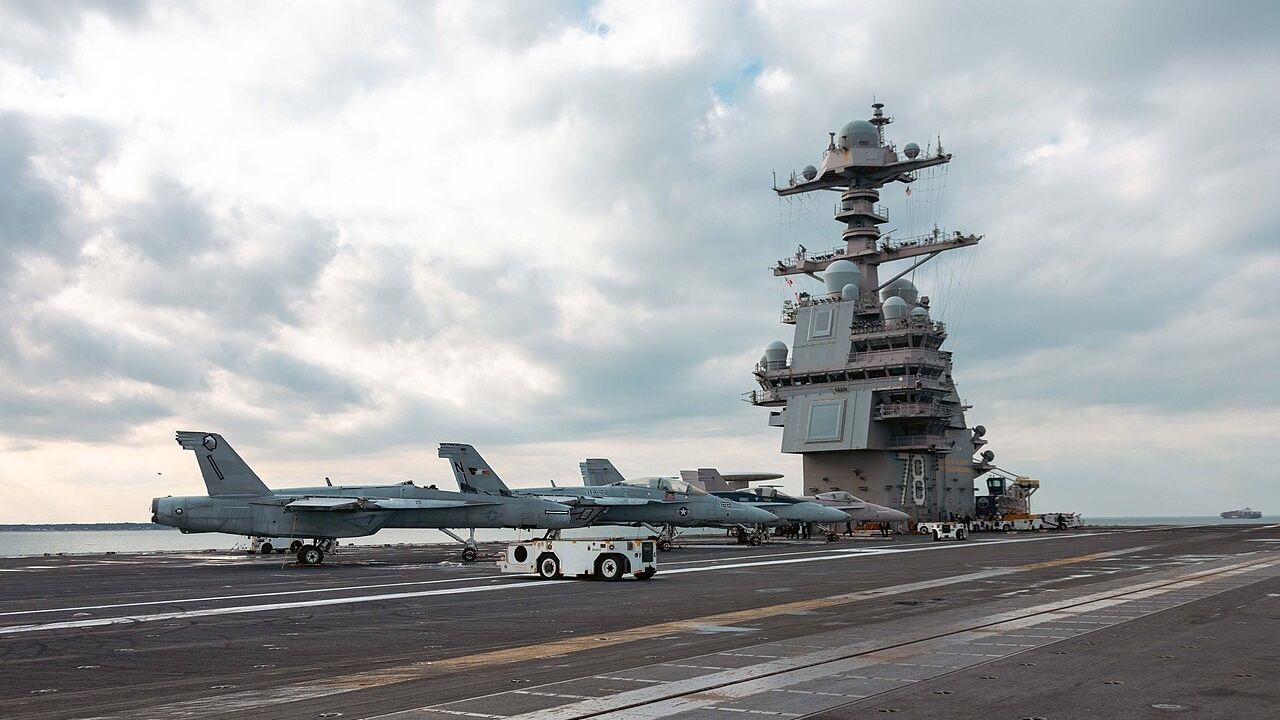
The Navy is examining whether to relocate the command tower on its newest class of aircraft carriers to match President Donald Trump's preference for warships that resemble those of World War II, a change officials say could cost billions of dollars and delay the program.
The Washington Post reported the review over the weekend, citing seven current and former U.S. officials. The structure in question, known as the island, houses the carrier's command center. On Ford-class ships it sits toward the stern. Trump wants it moved forward, closer to the middle of the deck, as it was on carriers of the 1940s.
The Navy studied the same change during Trump's first term. A former senior official said the review concluded that the cost and time involved would be extraordinary, according to the Post.
Officials said the rearward placement on Ford-class carriers was chosen for efficiency and safety. The layout frees deck space for aircraft near the catapults, shortens launch times and reduces turbulence during landings.
Bryan Clark, a former Navy officer now at the Hudson Institute, said relocating the island would amount to a major redesign affecting the ship's weight and buoyancy at significant cost.
One Ford-class carrier, the USS Gerald R. Ford, is in service. The USS John F. Kennedy is undergoing sea trials, and the USS Enterprise and USS Doris Miller are under construction. Navy shipbuilding plans call for up to 10 ships in the class over the next four decades at a projected $22 billion each, according to the Congressional Budget Office.
The review follows a national security memorandum Trump signed Thursday directing the Navy to develop a plan to return to steam-powered catapults on future carriers, replacing the electromagnetic launch systems used on Ford-class ships. That change would also carry a cost in the billions.
Sen. Mark Kelly, D-Ariz., a former Navy captain and astronaut, criticized the president's involvement in ship engineering, noting that he had launched from carrier decks hundreds of times and holds a master's degree in aeronautical engineering, yet would not advise the Navy on its systems.
The Pentagon and the Navy referred questions to the White House, which pointed to the new memorandum. The memorandum does not address the island's placement.