
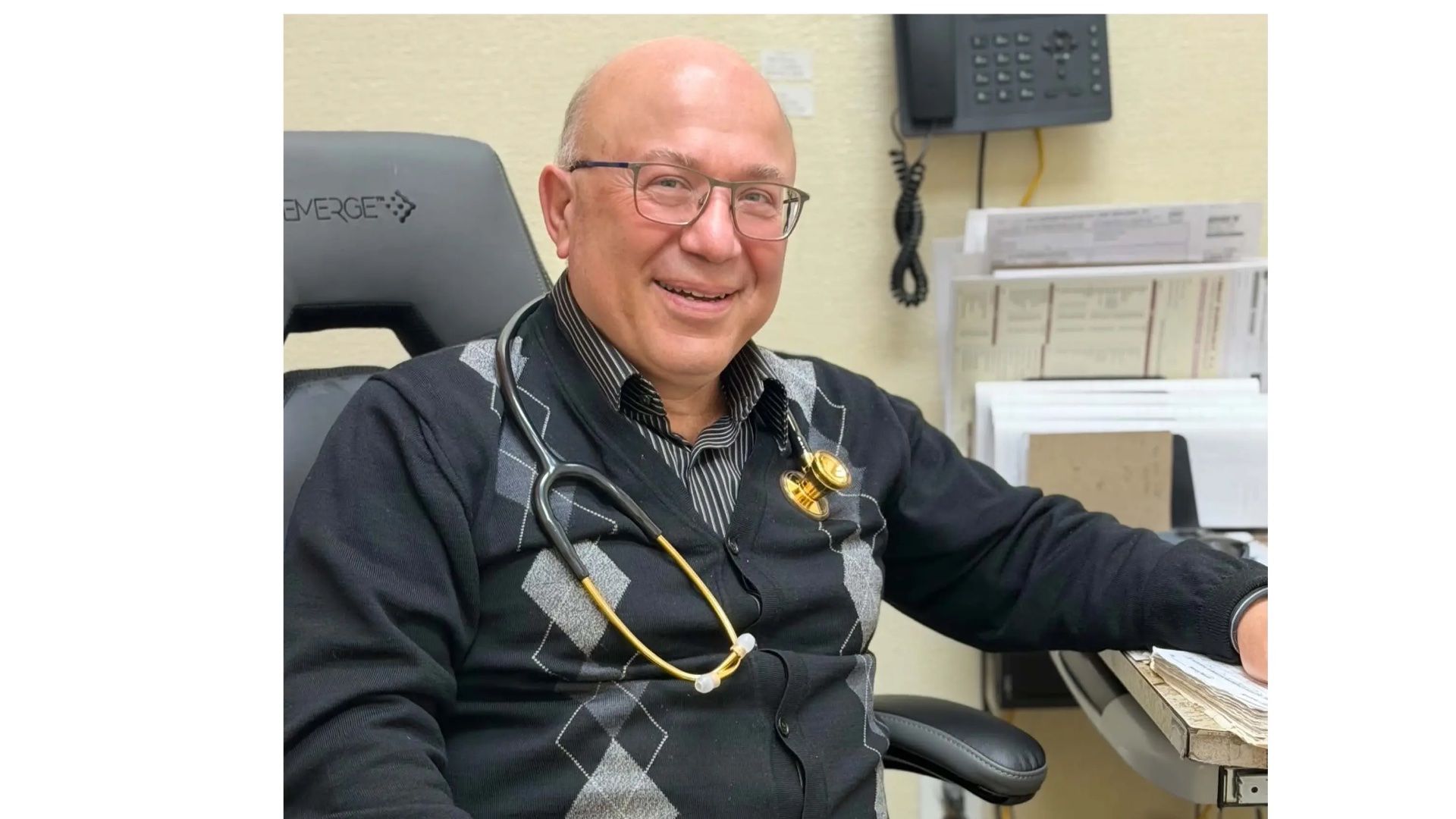
Dr. Mikheil Tavdi was 37 when he arrived in the United States in 1994. He had graduated from medical school in 1980 and spent more than a decade practicing in Georgia, but he had studied German in school, not English, and the language he needed to practice medicine here was essentially closed to him.
For two years he lived on his wife's paycheck in a one-bedroom apartment with their toddler daughter and his mother, and spent his days in a public library, teaching himself enough to sit for the American licensing exams. He passed the first two on his first attempt. He has worked in the same Brooklyn office for nearly 24 years, and eventually bought it.
Before the pandemic, Georgian patients made up less than 1% of his practice. Today they account for about half. In this interview, Tavdi talks about the years it took to rebuild his career, the phone consultations he gave Georgian immigrants across the country during the COVID-19 crisis, and what he learned returning home after three decades away.
Q: Let's start at the beginning. How did you get here?
Tavdi: We came to America about 31 years ago, in 1994. My brother was living here and he sponsored us. As for my professional background, I finished medical school in 1980, so I've been in medicine for more than 45 years now. I was a very young student. I graduated from secondary school at 16, went straight into medical school, and by 22 I was already practicing as a physician in Georgia.
Q: How old were you when you arrived?
Tavdi: Thirty-seven. And I have to be honest, I didn't really know the language. At that time, schools in Georgia divided students by foreign language. Half studied English, half studied German. I was in the German group. I could follow some English, but I wouldn't call that knowing it.
Q: Given that, how did you decide to continue as a doctor here?
Tavdi: When we arrived, my wife and I had a 2-year-old daughter. We decided she would go to work and I would study. My instinct was that I should be the one earning, but we concluded I had the better chance of getting back into my profession. So we lived on her salary, all four of us, because my mother lived with us too, in a one-bedroom apartment. I gave myself about two years. If I hadn't made progress by then, I would have had to consider another path.
Q: How did the studying begin?
Tavdi: A week after we landed, I went to the library. I didn't waste any time. In a given year I might have taken four days off. Weekends, holidays, none of it mattered. I was there from 8 in the morning until 8 at night. I wasn't alone, either. A lot of immigrants came through, Georgians among them. There were four of us at the time, and fortunately all four of us passed and became physicians here.
Q: The start must have been especially hard.
Tavdi: Extremely hard. The first book I picked up was a biochemistry textbook. I assumed it would be the easiest place to begin because so much of it was formulas. But I had to look up every second or third word. I wrote the translations right into the margins, and I remember thinking, will there ever come a day when I can read this without translating? It took me three months to finish that first book.
Q: When did you realize you were making progress?
Tavdi: My vocabulary kept growing and so did my confidence. I sat for the first exam about a year and eight months in, and I passed on the first attempt with a fairly strong score, an 84, which was high for that time. The average American test-taker scored lower.
Q: That must have been a turning point.
Tavdi: Of course. I understood that I could actually do this. I took the second exam six or seven months later. That one was easier for me because I had 12 or 13 years of clinical experience from Georgia behind me. I passed it on the first attempt as well, with a 90. That was a very high score in those days.
The English exam was the only one I failed the first time, which honestly wasn't surprising given that I had no practice with the language. I passed it on the second try.
Q: And then came residency?
Tavdi: Yes. The scores made a real difference. I had about 50 interviews, because when your numbers are strong, programs want to work with you. But by then I was exhausted. I had more than two and a half years of grinding work behind me. At my fifth interview they told me I could sign that same day if I wanted, and I signed on the spot. That's how I ended up in residency in Park Slope, at the hospital now known as Presbyterian.
Q: Did you work at all before residency started?
Tavdi: I did. There were a few months between the second exam and the start of residency, and my family needed the help. Our total household income at that point was $1,000 a month for four people. Rent was $800, and we got through the month on the remaining $200. When I think back on it now, I'm genuinely amazed we managed.
Q: How did you find that job?
Tavdi: I wanted something close to medicine so I could learn the American system. I went to an organization that helped new arrivals, and a woman there told me that a friend of hers had called from Brooklyn about an hour earlier looking for a medical assistant. I went to Brooklyn immediately and started working. I took patient histories, reviewed lab results, assisted the physician. That was my first real contact with how medicine works in this country.
Q: What was daily life like in those years?
Tavdi: Very hard, but very disciplined. We economized in ways that sound almost absurd now. We carried a small electric immersion heater so we could boil water for tea rather than spend money in the cafeteria at work. We even rationed phone calls, setting a specific time to talk to each other. But the important thing is that we got through all of it together.
Q: What happened after residency?
Tavdi: A physician offered me a position in his medical office. He said I knew the system well enough by then and should come work with him. That was right around Sept. 11. I finished residency in August, and the attacks came in September. I saw it with my own eyes. I was on high ground in Queens and watched the second plane hit. The next day, Sept. 12, I started work.
Later, that doctor moved in a different direction professionally and I took over the Brooklyn office, where I've now been for about 24 years. I bought the practice some time after that, and today it belongs to us. My wife had moved from a store job to a bank, where she had room to move up, but I couldn't run the office alone, so I asked her to join me. She resisted at first, but I convinced her.
Q: What matters most, in your view, if someone wants to build a successful medical career in America?
Tavdi: First, the capacity for hard work. Second, a clear goal. You have to know what you're after and be prepared to follow it all the way through. Without a goal, you won't get anywhere.
Q: How active is the Georgian medical community in New York?
Tavdi: In my view, there really isn't a unified Georgian medical community or a strong professional association of the kind we might want. There are individual people and individual connections, but an organized, influential Georgian professional body is something I just don't see. The one person who comes to mind is Nikoloz Chkheidze, who leads the Georgian diaspora organization Tvistoma and is very active on this front.
Q: A lot of your patients today are Georgian. Was that always the case?
Tavdi: Not at all. Before COVID, you could count my Georgian patients on one hand. They were less than 1% of my practice. Today it's roughly half. All of that changed after the pandemic.
Q: How did that happen?
Tavdi: During COVID everything shut down. The office was closed for about six weeks to two months. Then I reopened, because keeping it closed indefinitely made no sense to me. I had a hard time staying home in that period. I'm an active person by nature. I asked my daughter to look into whether there was any platform or organization through which I could be useful to Georgians as a physician.
The next day, one of my patients called and told me a crisis center had been set up that needed a doctor to speak with people by phone and prescribe medication where necessary. I agreed immediately. I told them to send me names and phone numbers and that I would call about 10 people a day.
Q: So you were doing telephone consultations for Georgians during the pandemic. The crisis center was set up by the diaspora organization Tvistoma, wasn't it?
Tavdi: Yes, and it wasn't only New York. People called from Texas, from Orlando, from all over the country. Georgians are scattered everywhere. In that period it was difficult for people to see a doctor, and they were afraid to go to the hospital because the system was overwhelmed. I did this for about six months. Some people would tell me they had good insurance and ask me to bill them. I told them there was no need, that I simply wanted to help.
Q: How much does that kind of support matter in an immigrant community?
Tavdi: Enormously. Especially for people who arrive without Russian, let alone English, and find themselves in a completely foreign environment. To be able to speak to someone in their own language and help them at a moment like that is invaluable.
Q: What was the turning point that brought Georgian patients to you in large numbers?
Tavdi: When the crisis center wound down and things gradually reopened, someone asked me for a photograph. They wanted to post a thank-you. I don't have Facebook or Instagram myself, but they published it and the information spread. That was the turning point. After that it was word of mouth. One person told another that a doctor had helped them, that person told a third, and it went from there. That's when the number of Georgian patients started to climb.
Q: The pandemic must have been emotionally brutal as well.
Tavdi: Very much so. I remember two Georgian patients in intensive care. One had almost total lung damage, the other around 80%. One of them, sadly, was a 34-year-old man we couldn't save. The other survived and spent six months in rehabilitation. He has a child now. At times like that you're not only a physician, you're also a psychologist.
Q: What would you say to someone who has just arrived and is still deciding whether it's worth trying to practice medicine here?
Tavdi: Don't think about it. Act. One hundred percent. The main thing is not to be afraid.
Q: Have you helped Georgian physicians yourself?
Tavdi: Yes. I've had three people from Georgia. They came to the office, I let them see patients, I helped them build practical experience and wrote recommendations for them. I did everything I could.
Q: After all these years, what would you say to yourself at the age you started?
Tavdi: I'd say: well done.
Q: You returned to Georgia last year for the first time in three decades. What was that like?
Tavdi: Deeply emotional. My daughter, who came here at 2, had always asked me to take her. I should mention that she followed me into medicine as well. She works as an internist at Yale's university medical center. I wanted to show her where we came from, where I was born, which house we lived in.
Georgia had changed a great deal, and in many ways for the better. What impressed me most was the young people: educated, multilingual, ambitious. That made me very happy. I'll also say that I'm from Kutaisi, and it was painful to find the city so emptied out. It was August, the weather was beautiful, and there were exactly two men sitting in the central park. The market was nearly deserted too. That feeling stayed with me, that the people are gone.
Q: Finally, what's your main message to the Georgian community?
Tavdi: Probably this: love your family, your country, the place where you live. Everything starts with family. A person has to want something better. And we have to care for one another and help one another. That's what gives us strength, both us and the people we help. It's the only way anyone moves forward in life.
This interview was first published in Georgian by Accent. It has been translated and edited for The Gazette New York.