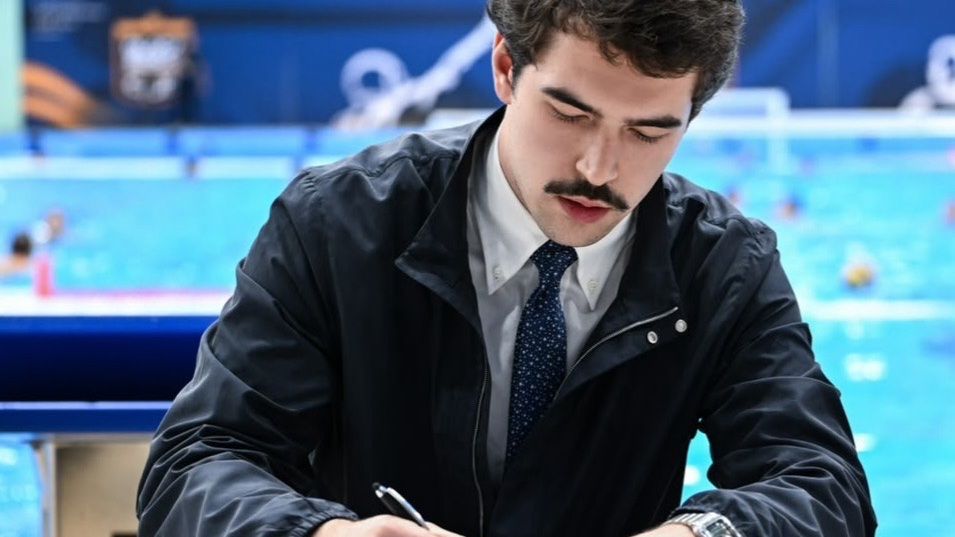
Originally from Georgia, Givi Abdushelishvili previously studied in the United States and is now pursuing a degree in Luxury Industries Management at Glion in Switzerland, while simultaneously growing his business in Georgia.
Q: Givi, let’s start with Switzerland. What is student life like at Glion, and what kind of environment did you find when you arrived at the university?
A: Glion University has a very interesting and multicultural atmosphere. I love it for many reasons: the professors, the instructors, the teaching methods, and, of course, the students who come from all over the world. Here, daily interaction with people from different cultures and backgrounds is part of the learning process. I think this is one of the university's greatest strengths.
I also like that the education is connected to practice and focuses not only on academic achievement, but also on the student's personal and professional development.
Q: The university recently entrusted you with a very important role. You were elected to the university's governance and were given the financial direction, that is, the position of Treasurer. What does this choice mean to you?
A: Above all, trust and responsibility. As treasurer, I oversee the financial affairs of student committees across the university.
Of course, I'm glad the university has placed its trust in me, but for me, it's responsibility above all else. I believe the importance of any position lies precisely in the trust and responsibility it imposes.
This experience is important to me because it gives me the opportunity to apply the management principles I'm studying at university.
Q: You're studying management in the premium and luxury industry. Why did you choose this field?
A: I'm interested in how high-quality products and services are created, how teams are managed, and how customer experience becomes an integral part of business.
For me, the luxury industry isn't just about expensive products. Quality, attention to detail, service, brand culture, and the experience you offer the client are all important.
Q: While studying, you also worked in a hotel. How important is practical experience for you?
A: It is impossible to learn management only in the classroom. If you want to become a manager in this field in the future, you need to understand firsthand how the system works in real-life settings, what responsibility is, and how decisions are made in everyday situations.
Working in a hotel gives me exactly this experience: I see processes in action, interact with people, and learn how the service industry operates in real-life settings.
Q: Despite your young age, you already have a functioning business in Georgia, the “Martivi” company. Tell us how the idea for this company came about.
A: The idea behind “Martivi” is based on a combination of technology, innovation, and environmental stewardship. It's a network of charging stations for electric vehicles in Georgia.
We wanted to create a service that would make people's lives easier, save time and money, and simultaneously contribute to a more environmentally friendly environment.
Today, “Martivi” is one of the largest networks of EV charging stations in Georgia. It's especially important to me that this initial idea has evolved into a real and growing business.
Q: What does business mean to you: simply commercial success or a larger idea?
A: For me, business is, above all, turning an idea into reality.
If you create something that brings real benefit to people, the importance of business increases significantly. Commercial success is important, but for me, it's not the only criterion. What matters is what you create, what problem you solve, and what impact you have on people's daily lives.
Q: You speak many languages and have lived in many countries. What have you gained from this experience?
A: Of course, all of this had a huge impact on me. My grandfather and uncle both served in diplomacy at various times, including as Georgian ambassadors, and my father works in business, and his company is also multinational.
From childhood, I saw what it means to interact in an international environment, be responsible, communicate with people of different cultures, and represent my country.
At the same time, I always wanted to forge my own path and connect these experiences with my interests and goals.
At various times, I have lived in Central Asia, Uzbekistan, America, Georgia, and now Switzerland. This diverse environment has probably given me the opportunity to better understand people and different cultures.
Living in different environments teaches you to adapt, communicate, and find common ground with different people.
Q: You mentioned several times in our conversation that you love your homeland - Georgia. Is a cosmopolitan vision compatible with your own Georgian identity?
A: For me, these two things are not at all contradictory.
You can live in different countries of the world, get to know many cultures, and at the same time know very clearly who you are and where you come from.
On the contrary, getting to know other cultures will reveal your own identity even better. The more different environments you get to know, the better you understand what is most important to you and what you have the strongest connection with.
Q: As you mentioned, Switzerland is an important experience for you. What would you like to bring to Georgia in the future from this experience? And again, are your long-term plans related to Switzerland or Georgia?
A: There is a lot to learn from Switzerland, from the education system and management culture to the business environment and high standards of service.
What is interesting to me is how this experience can be adapted to the reality of Georgia and transformed into concrete, real results.
I don’t think that you can directly transfer the model of one country to another. It is important to understand the principle that works, and then adapt it to your own environment.
I greatly value the experience I gained in Switzerland, but in the future I want to use this knowledge and experience in my own country.
It's important for me to gain international experience, but ultimately, I want this experience to not just remain for personal development, but to return to Georgia in some form, be it business, new projects, or other opportunities.
Q: Finally, Givi, what do you most want to create in the future?
A: I want to create something that will bring real benefit to people and, at the same time, benefit my country.
It is important to me that whatever I do does not remain just an idea. I want the idea to turn into a real thing, a real business or project and have results.
Perhaps this is what I'd most like to do in the future: to create something important that will last longer than I do.